Teaching an agent maths, and why I stopped asking it to do any
I did a course on agents and skills and came away thinking I understood the shape of it. Then I built one for production, and the actual work turned out to be somewhere else entirely.
It is not really programming. You write a rule; the model follows it in four cases out of five and improvises the fifth. You tighten the wording; a different rule that was fine yesterday goes soft. It is much closer to teaching a clever but inattentive teenager: they can do it, they simply stop paying attention halfway through the question. So you stop explaining and start removing the opportunity to be inattentive.
Ask the model for less
Our image agent takes a sentence like score update from last night and turns it into a design. Dates are everywhere in that, and dates are exactly where a language model is least trustworthy — it will confidently tell you which weekday a date falls on, and it will be wrong often enough to matter.
So the agent does not do date arithmetic. It has two tools, date-today and
calculate-dates, and a helper module that is ordinary, boring, tested
TypeScript. Every genuinely hard case lives there, in code:
// "Monday 05/04" — the year the user never said
if (thisYearDate?.getUTCDay() === weekday) return thisYear
if (nextYearDate?.getUTCDay() === weekday) return thisYear + 1
// the weekday matches neither: discard it, choose by proximity
That is the whole philosophy of the thing. If it can be computed, compute it. Every decision you move out of the prompt and into a function is a decision that stops being probabilistic.
The interesting part is deciding what a person meant
A user types a date that cannot exist, or one that has already gone past, and something has to decide what they intended. That is not a coding problem, it is almost a philosophical one, and it is the part I enjoyed most.
It comes down to grace windows. A bare 04/12 that passed two weeks ago is
almost certainly this year — someone posting a result. The same date eight
months past is next April. So the helper carries a 150-day past-grace window for
a plain month/day. But when the user also wrote a weekday, the weekday becomes
the evidence: it picks the year outright, and only if it matches no candidate
year does the code fall back to proximity — on a deliberately tighter 90-day
window, because a wrong weekday is weaker evidence than no weekday at all.
There is a third case I like even more. The agent sometimes attaches a year the user never gave, and the weekday it also produced contradicts it. Rather than trusting either, the code searches forward a few years for the year where that weekday and that date actually agree. The model's own inconsistency becomes the thing that catches its mistake.
None of this is difficult code. Deciding what the rules should be took far longer than writing them.
Evals are the actual job
This is what the course did not prepare me for. You cannot unit-test an agent: run the same prompt twice and you get two different sentences, both correct.
So we built scorers. Each one is a dataset of prompts paired with ground truth, and a function that scores the output between 0 and 1. The event-coverage scorer checks that a schedule request forwards every event to the image tool — nothing dropped, nothing invented — by matching produced events against expected ones field by field, one-to-one, so a duplicate cannot paper over a miss.
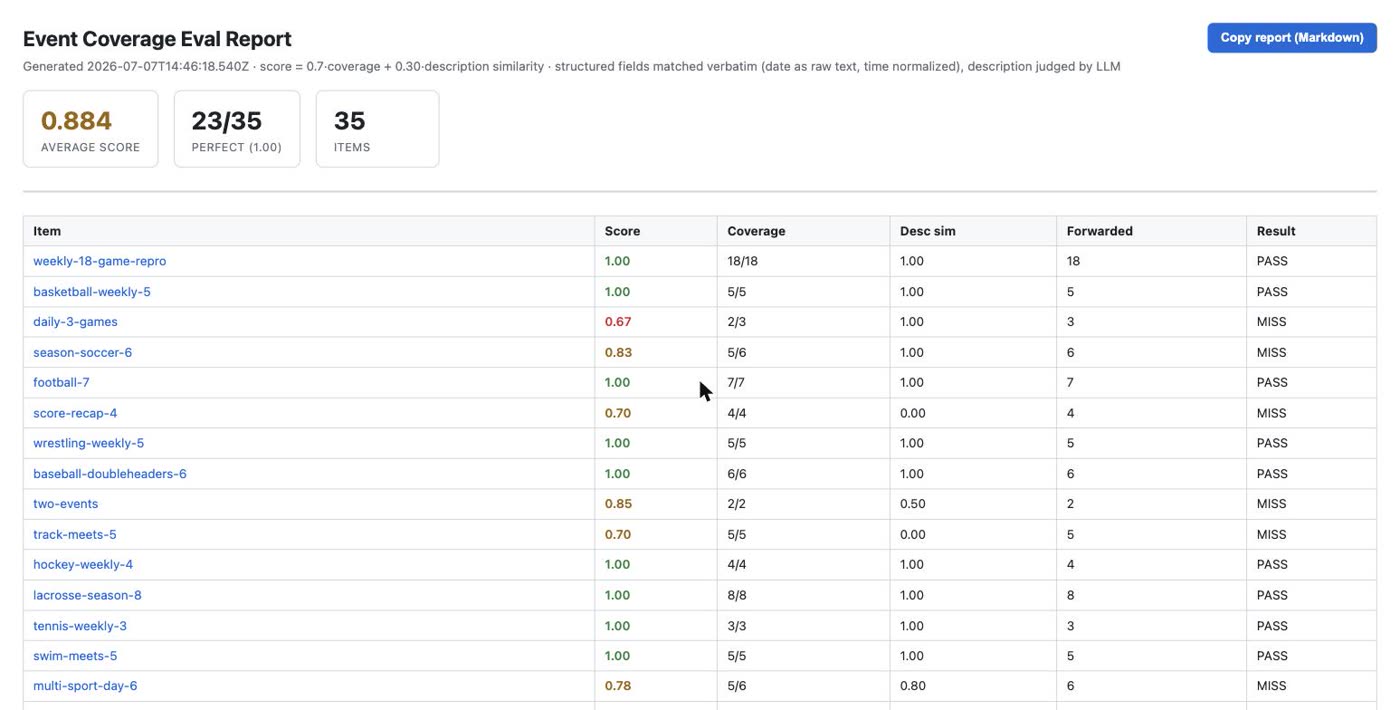
A run gives you a number and a list. 0.884 average over 35 prompts, 23 of them
perfect — and, more usefully, the twelve that were not. daily-3-games forwarded
three events and only two matched. score-recap-4 covered every event and still
scored 0.70, because its description similarity was zero: right facts, wrong
words. Those are two completely different bugs, and a single pass/fail would
have hidden both.
Two details made them actually useful:
Score the structure exactly, the prose approximately. Sport, level, opponent and location are compared verbatim. Only the free-text description is judged semantically, by a second small agent. Mixing those two kinds of comparison gives you a number nobody trusts.
Test what the model should refuse to do. Half of one dataset is prompts
where the user gave no time at all, aimed at a template that has a time slot.
The ground truth is null. The score drops if the agent invents a plausible
7:00PM to fill the gap — which it very much wants to.
The date helpers, meanwhile, have 82 ordinary unit tests. They are deterministic because I made them deterministic. That contrast is the whole lesson: the more work you move out of the model, the more of your system you can actually test.